Nature · 2008
Kemp elimination catalysts by computational enzyme design
Showed that enzymes could be designed from first principles to catalyze reactions not found in nature — a foundation for industrial biocatalysis.
Read publication
We combine Nobel Prize-winning computational methods with modern AI and a proprietary 15-year protein design dataset — so every program starts from physics, data, and manufacturing reality, not guesswork.
Engineering at a different scale
Random mutagenesis was the best tool available for decades. Today, Arzeda designs enzymes with atomic precision — then proves them under conditions that match your application.
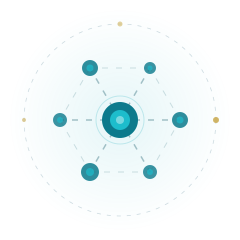
Design
The amino acid search space for a single protein is larger than the number of drops of water in the Pacific Ocean. We navigate it with proprietary algorithms that blend machine learning with Rosetta-class physics — the same scientific lineage that produced the 2024 Nobel Prize in Chemistry and co-founder David Baker's decades of breakthroughs.
Every design is grounded in energetics, structural feasibility, and learnings from our own multi-year dataset — not generic models trained only on public sequences.
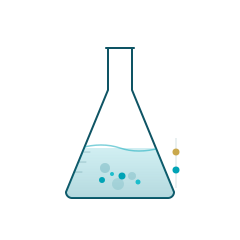
Test
We validate candidates in application-relevant conditions — pH, temperature, cofactors, and matrices that match what you will see at scale.
That means fewer false positives from assays that look impressive on a spreadsheet but fail in the plant or on the shelf. We optimize for real-world performance, not high-throughput guessing.
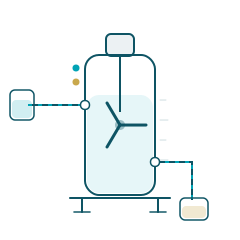
Manufacture
Most computational platforms stop at a sequence. Arzeda delivers protein at the scale you need — from milligrams for early development to metric tons for commercial launch.
Integrated production capability is how we close the loop between design and deployment, and it is a gap many pure-software competitors cannot bridge.
Our models and playbooks are trained on outcomes from real programs — successes, failures, and the subtle constraints that only appear when you design, test, and manufacture in one continuous system.
Peer-reviewed foundation
Arzeda's platform stands on a long arc of peer-reviewed enzyme design — from first demonstrations in top journals to the methods we use in production today.
Nature · 2008
Showed that enzymes could be designed from first principles to catalyze reactions not found in nature — a foundation for industrial biocatalysis.
Read publicationScience · 2008
Demonstrated end-to-end computational design of a new enzyme fold and active site, validating the design-build-test loop Arzeda still runs today.
Read publicationScience · 2010
Extended computational enzyme design to complex multi-substrate chemistry — the kind of selectivity partners need in real products.
Read publicationScienceDirect · 2014
Synthesized a decade of methods and results into a clear roadmap for how computation, not random screening, drives enzyme discovery.
Read publicationPublication links are placeholders; replace with DOI or publisher URLs when available.
Open science
Arzeda helped launch OpenFold, a consortium committed to open-source tools for protein structure prediction and design.
We believe the field moves faster when foundational models and benchmarks are shared — while our partner-specific IP remains protected inside each program. OpenFold is one expression of that balance: public infrastructure, private advantage where it matters.